Rahr! Beware Peter the scary tiger! Rahr!



 Six months, six months. It's been six months now since we pulled up stakes and left Oregon on the rambling journey that would eventually end us here in New Zealand. And yesterday, I got a letter in the mail approving me for NZ residency, which basically means I'm all but a citizen and don't get kicked out of the country next October. And free govt. health care! Hoo-hah! It wasn't really in doubt I'd be approved what with the kiwi wife and son but it could've been more difficult than it was.
 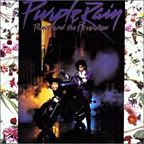 25. Prince, "When Doves Cry." That bizarre, robotic drum machine beat, elongated by stripped, raw heavy metal guitar lines, then an oddly poppy synthesizer melody – anyone who grew up in the '80s knows this song before the singer opens his mouth. In 1984, "When Doves Cry" freaked me out, burning out of the radio like static from another planet, Prince's insectoid voice buzzing about animals striking curious poses. It sounded like nothing else on the FM radio station I usually listened to. I didn't realize until just the other day that this song has no bassline – perhaps that gives it some of its creepy-crawly allure. Twenty-plus years on, the sheer rattling strangeness of it stays with me. Prince's main lyrical topic is doin' it, but here, his usual slinky sex talk morphs halfway through into an anguished conversation with someone – God? — and anyone that's ever wronged him in his life. It's the sound of a breakdown. How could you just leave me standing, indeed? The #1 selling single of 1984, which shows popular sometimes can be good for you. "Dig if you will the picture / of you and I engaged in a kiss"
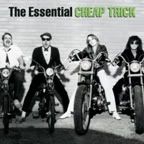 26. Cheap Trick, "The Flame." Oh man, my street cred just went out the window. Not everyone loves Cheap Trick, and even those that do probably consider this 1988 ultra-sappy ballad among their lowest moments. But this almost absurdly over-the-top love song I submit to you as among the finest achievements of that maligned genre, the power ballad. The power ballad has as its one and only goal the notion of making your love affair seem like the greatest thing that's ever happened to anyone in the world, of capturing that sensation that your romance is the center of the universe, "whatever you want, I'll give it to you." It's a manipulative track, of course, but Cheap Trick's ace performance and Robin Zander's utterly sincere vocals sell the sugar. Here's the power ballad for the ages. And shoot, it brings back lovelorn memories of high school proms to me. So there you go. (And I won't even tell you how Peter Cetera's "The Glory of Love" almost won the power ballad spot on the list.) "After the fire, after all the rain / I will be the flame."
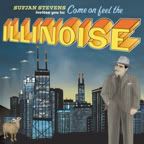 27. Sufjan Stevens, "Chicago." Let's keep this from being the all-1980s chapter of this never-ending saga. Here's something from this decade that I so far never tire of. This beautiful song, with a message like a calming mantra, evokes hope in the moment when it's darkest. "Illinoise," Sufjan's lush 2005 concept album about Illinois and life in general uses this as its emotional centerpiece – an effortlessly epic, heartfelt tune about taking a chance and asking for forgiveness. Sufjan's childlike voice, sweeping orchestration and sturdy backup singers craft a sincere anthem in an age overflowing with insincere chart-toppers. It's vague enough that it can apply to anyone who's ever felt down and out, specific enough that you can see the corn fields as the song's narrator drives to Chicago, "I made a lot of mistakes, in my mind, in my mind." Sufjan's music contains a lot of nods to his Christian faith, and this track can certainly be seen in that vein – surrendering to God for your sins – but in my kinda agnostic sort of way, I just like it as the sound of a man in trouble pausing for breath, gathering courage to examine his life and starting over again. "All things grow, all things grow."
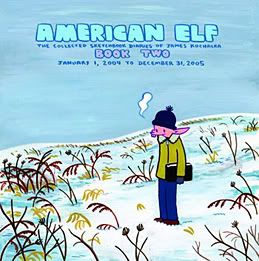 Lots of folks have a diary. But not a lot of people have a cartoon diary.
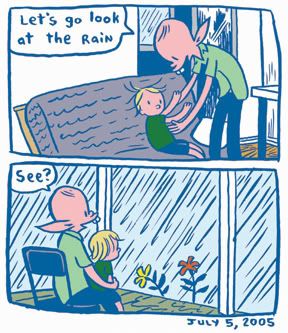 Kochalka channels the observant spirit of "Peanuts" creator Charles Schulz combined with an underground anything-goes spirit. There's no rules as to what he covers – a strip can be about a fight with his wife, something cute his kid said, or a random sketch of a day's detail, like a weirdly-shaped icicle or a piece of cheese on the ground. Read a huge bunch in one go and you start to see the world Kochalka's way. Everything looks a little more cartoony in real life.
 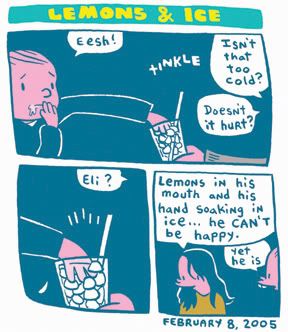 It could be said that "American Elf" is getting a bit formulaic as it enters its eighth year and beyond – it's a little less experimental than it was in its earlier days, more a collection of punchlines than of deep thoughts about life. But I don't really see it that way. If anything, I've grown to enjoy "American Elf" more in these later years, as Kochalka's recent adventures in fatherhood mirror my own life and I find myself smiling knowingly at the million strange and funny moments that a kid brings into your world.
 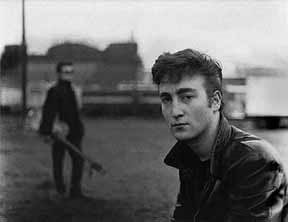 • Been on a bit of a Beatles kick lately (it's required to go through one once a year or so if you often blog about music), and so I revisited the 1994 biopic of their early days, "Backbeat," the other night. Hadn't seen it in years and was surprised by how much I enjoyed anew this take on the Beatles' early Hamburg, pre-fame days, when there were five Beatles and Ringo wasn't in the picture yet. The flick focuses pretty much on John Lennon (Ian Hart) and bass player Stuart Sutcliffe (Stephen Dorff) and their complicated friendship as the struggling Beatles play in assorted Hamburg strip joints and dives trying to get a foothold in the music biz. "Backbeat" has a keen eye for debunking the "moptop cute Beatles" image. It nicely depicts the grime and grit of those early, speed-fueled Beatle years, when they were more punk than pop in their assault, having to play six, seven, eight-hour gigs in something closely resembling indentured servitude. The inhuman work load, terrible living conditions and stress was the fire that forged the Beatles from amicable band into something that would become legendary. "Backbeat" pulses with a cool energy as it romps along these early days. The soundtrack doesn't feature a single Lennon/McCartney tune, focusing on the rock and R&B covers the Beatles made their early name with. "Backbeat" captures the vibe of the early Beatles beautifully (even if it gets a bit too many winks in to the band's famous future - "we're gonna be too big for our own bloody good," Lennon says at one point).
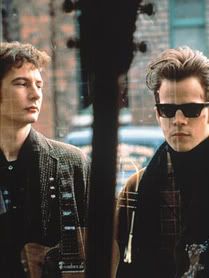 More than a decade after "Backbeat's" release, Ian Hart's performance as the angry, bitter young Lennon is still remarkable to watch – without precisely imitating Lennon, he effortlessly evokes him. Dorff's Sutcliffe is easier to play — because how many people really know what Stuart Sutcliffe was like now? — but it's also a fine acting turn, as is the gorgeous Sheryl Lee of "Twin Peaks" fame as seductive German photographer Astrid Kirchherr. Sutcliffe's sad fate in history is well known - a dispensable fifth bandmate whose bass playing was never spectacular, he was in it for a lark. Stu left the band amicably before they became stars, returning to his first love in art. But then he died not long after at the terribly young age of 21 of a cerebral hemorrhage. He's one of these vaguely haunting figures lurking at the edges of the Beatles' history, whose short life makes him seem mysterious and cool in a doomed way (an attribute "Backbeat" diligently exploits). Yet by age 21, the man was a very promising young artist, had a glorious adventure in Germany and fell in love with a girl, and became a Beatle. There are worse epitaphs.
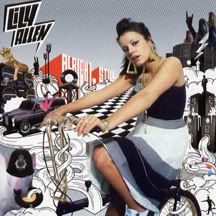 On the cover of her debut CD Alright, Still, Lily Allen perches on a pop-art bicycle in a carnival version of London. Her head is tilted and she looks on the verge of launching a slick, smooth putdown. It's the look of the smartest kid in the class who's decided to become a troublemaker.
 ...So I haven't really been feeling the blogging lately, down to posting just once or twice a week. Part of it is the daily routine we've settled into here as "Mr. Mom" and fumbling aspiring freelance writer – there's not a lot to say really about it, and there's only so much "look how cute my boy is" posts one can get away with. And while we've been doing a lot of fine visits to beaches, again, only so much you can really say. As for the New Zealand/U.S. cultural differences thing, I'm just not out and about enough right now to suss that out.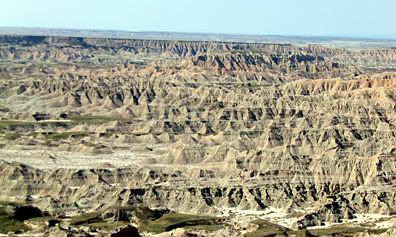
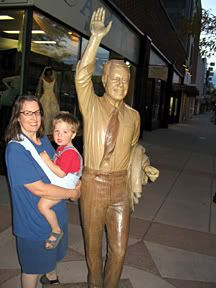 Rapid City really doesn't make a tremendous impression (I was appalled with the Sunday newspaper there – the one I'd worked for back in Oregon in a much smaller town was yards better). But one thing about it is exceedingly cool – downtown, to capitalize on the whole Rushmore/Presidential history of the area, they've been gradually erecting life-size bronze statues of every single president, from Washington to Warren Harding to Clinton. I found this bizarrely cool. They haven't finished all the presidents yet – about 25 of them so far, I think. I would support this use of my taxpayer money for the simple geeky oddness of it. (You can find pics of most of the statues here.) They're all clustered in a section of downtown on various street corners. We all walked around downtown in the evening and looked for statues. The Jimmy Carter statue was a particular favorite, pictured here. The Nixon one is in a total "Dr. Evil" pose, though. Rapid City also has a mysterious Dinosaur Park on a big hill overlooking the entire town, which boasts some rather run-down and cartoony giant dinosaur statues. It's a bit peculiar to look up and see a brontosaurus on a hill watching your hotel room.
 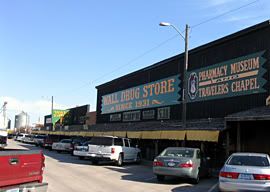 We used Rapid City as our base to zip eastwards, away out of the Black Hills and toward the raw and rugged Badlands National Park. On the way, we had to stop at the amazingly self-promotional, "world famous" Wall Drug. You'll find signs for this store all over the Midwest – we spotted them in the middle of Wyoming – goofy little "Burma shave" type signs advertising their "free ice water" and "5 cent coffee". My dad went there once in the 1970s and told us we had to go. This store is a piece of true Americana, kitschy and sprawling and kind of amazing – it's actually several dozen stores crammed into one city block in the wee-tiny town of Wall, about 40 minutes east of Rapid City. It's all owned and run by the same family and has been since the 1930s, and has a kind of cowboy-western theme going on – rambling shops, museums, restaurants, even a giant mechanical T-rex that scared the beejeezus out of Peter. Definitely a lot more fun than your typical Interestate rest stop.
 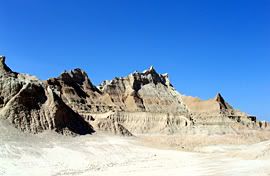 If the foresty, rambling Black Hills are the opposite of the prairie, the Badlands are the Bizarro inverse. You head east from Rapid City for about an hour, and the land flattens out like a huge tan blanket, gently rolling hills. The Badlands erupt slowly out of this calm, fragmented chunks of land like out of a Cormac McCarthy novel – they were created by erosion over millions of years. The effect they create is startling – it's pure chaos of geology and astoundingly vivid and detailed, sunken down into flat prairie. One of the richest fossil beds in the world, it's like visiting the moon or something – especially when you drive right down into the pinnacles and spires themselves, which form some astoundingly jagged shapes. The only place I can compare it to is Southern Utah, which has the same unearthly allure.
 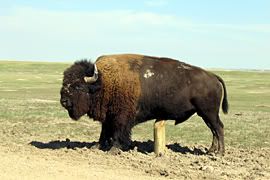 At Badlands, we also got our first glimpse on this trip of the American icon of the Great Plains, the bison. It's amazing, and more than a bit sad, to think that kazillions of these huge beasts used to roam the fields before we human beings wiped most of them out. They're being reintroduced in national parks, though, and we came across a small group of 4-5 of them here, including one obliging fellow who was, um, scratching himself on a fence post not 10 feet from us. Seen up close, these monsters are really impressive – nothing like meek, boring cows, they're huge grunting slabs of meat and muscle that look like they could easily knock your mid-sized SUV over a cliff if they wished. It was actually a little scary being so close to one without a fence – hope that scratching kept him in a good mood! (We'd end up seeing a huge old herd of nearly 100 bison in Yellowstone National Park a few days later, which this served as the appetizer for.)
 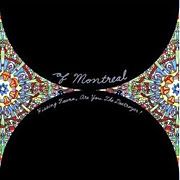 Of Montreal's dark and questing "Hissing Fauna, Are You The Destroyer?" is like the sound of a nervous breakdown with a beat you can dance to. The Athens, Ga.,-based group of Montreal sprang out of the mind of Kevin Barnes. "Hissing Fauna," of Montreal's eighth album, is a darker, more self-obsessed turn than the more gleeful pop of the previous work. A loose concept album about depression and elation, "Hissing Fauna" uses music as a muse. Barnes, who wrote and recorded much of this alone, dealt with suddenly living in a foreign country, a new child, marriage concerns and more in a chaotic year. "Hissing Fauna" is him trying to make sense of it all. "Hissing Fauna, Are You The Destroyer?" is lavishly orchestrated pop, complete with an elaborate fold-out case that resembles a blooming hippie flower. Song titles that are almost willfully goofy – "Sink The Seine," "Gronlandic Edit," "Bunny Ain't No Kind of Rider" – are tacked onto some ornate, creative and occasionally infuriatingly bizarre songs. Of Montreal's spinning electic frenzy may turn off as many as it appeals to. But the soaring highs and crashing lows of "Hissing Fauna" cohere into a dazzlingly creative if imperfect album. Take the first track, "Suffer For Fashion," which launches along on keyboard riffs and optimistic choruses that could've come straight out of an Erasure concert. It's followed soon by "Cato As A Pun," which crashes down to earth in a lonely disco groove. "I guess you just want to shave your head/ have a drink and be left alone," Barnes laments. The howls and catharsis of "The Past Is A Grotesque Animal" are the disc's highlight, building steam over nearly 12 minutes into a jittery Bowie-esque soundscape, Barnes raving about the state of his heart to a swelling, monotonous background of electronic beats, coos, squeals and riffs. "It's like we weren't made for this world / Though I wouldn't really want to meet someone who was," he says at one point. The song's heft comes from its sheer tension, the sensation that something huge is at stake here. The track divides the album cleanly in two parts - a "down" side and an "up" side. The second half of the disc, coming after the massively emotional "The Past Is A Grotesque Animal," is a little light and twee, with a few rambling, unfocused jam-pop melodies that lack the tightness of the album's best tracks. While it's not the easiest album that will come out of 2007, "Hissing Fauna" is definitely one of the most ambitious. I'm already a lot fonder of it than I was the first few times I listened to it, wondering, "what is this lunacy?"
  Their name is Japanese; their influences are German, their new album "Transparent Things" is named after a novel by Russian Vladimir Nabokov. But Fujiya & Miyagi are actually a Brighton, U.K. trio releasing their first disc stateside, full of bleeping, sardonic wit and atmospheric vibes. "Transparent Things" collects a stew of the band's British singles together. Fujiya & Miyagi have brewed up a drifting soundtrack to ennui, down-tempo dance tunes for a rainy drive or a 3 a.m. ponder. The songs never quite explode into full-out release, but amble along in a groove that's gently uplifting. Circling, repetitive riffs flow along with deadpan surrealistic vocals to create a systematic mood throughout "Transparent Things." At its best, it all induces a trancey reverie about the always-on, wired world we live in – or as vocalist David Best gasps in the title track, "I look through transparent things and I feel OK." "Cassette Single" updates and homages the Kraftwerk instrumental sound over a 6-minute trek, while the lullaby "Cylinders" sounds a bit like a trippy cover version of a song by '80s act The Church. "Ankle Injuries" has a propulsive drive and winkingly repeats the band's name over and over until you space out into the ether. "We were just pretending to be Japanese," Best whispers in "Photocopier," undercutting the solemn sway of some of the music by telling us it might all just be a big game. They even quote the old tune "Dem Bones" extensively in the goofy "Collarbone." The music's foundation of the hallowed kraut-rock gods Can, Kraftwerk and Neu! blend in with more modern wry disco-punk tints; fans of LCD Soundsystem's amped-up irony-techno might dig this as the chilled-out, egghead sibling. Fujiya & Miyagi might be transparent things, but you can see an awful lot of things in a reflection, after all, can't you?
