Showing posts with label Beatles. Show all posts

Saturday, July 2, 2011

Nik's Unheralded Albums #6: Julian Lennon, "Mr. Jordan."

I do feel bad for the children of rock stars. Never mind all the lunacy involved around growing up being Keith Richards Jr or whomever, but then there’s the impossible expectations that come if you decide to follow in their footsteps. The music world is littered with Frank Sinatra Juniors, Jakob Dylans and so forth.

One kind-of-success was John Lennon’s oldest son Julian Lennon. He had a few minor hits back in the mid-1980s, then sank from sight. His first two albums were what I'd call perfectly pleasant pop -- with their biggest attraction Julian's startling similarity to his late father's voice. But only so much can be done with nostalgia, so Julian Lennon never quite rose above one-hit wonder status with his single "Too Late For Goodbyes."
 
Yet Lennon Jr. continued plugging away, and surprised with his third album, 1989's "Mr. Jordan," a more sonically adventurous little gem – the kind of pop that’s often called “Beatles-esque” which here at least can be traced partly to genetics. I’d say it’s the highlight of Julian’s brief recording career, with a self-assurance that his earlier work lacked.  The mellow singer-songwriter vibe has been replaced by a grittier, more experimental sound that really works well.

The very first track of "Mr. Jordan" announces that we're moving on from John Lennon to David Bowie as an influence, with Julian boasting a deeper, sturdier singing voice than before, more willing to expand his range. "Now You're In Heaven" pulses with a strong beat and crunchy guitar riffs, sounding like a lost single from Bowie's "Lodger." "Open Your Eyes" bounces along on a very '80s Human League keyboard line, mashed together with a dash of "Tomorrow Never Knows" swirl. "Angillette" is a sweeping ballad that does echo "Mind Games"-era Lennon, but is tinted with Julian's own distinctive ache. With "Get Up," Lennon reaches further back into rock history with a loose-limbed rockabilly pastiche. Everything-and-the-kitchen sink album closer "I Want You To Know" is a psychedelic romp that piles on the soundscapes (at one point Lennon sounds like he's singing while marching underwater). "Mr. Jordan" is a magpie of an album, with Julian trying on a variety of musical hats, some of which fit better than others. His willingness to experiment is bracing and he sounds far more free than he did in his earlier work. But after a couple more albums, that was it for Julian's music endeavors.
 
Lennon seems to have given up the music biz, and I can’t say I blame him – it rarely turns out well for pop kids. But over his brief heyday he delivered some material that moved well out of his father's shadow. (The music of his half-brother Sean, whose own hipster-ish solo records got a bit of hype in the 1990s, has aged far less well to me.) While Julian Lennon can't ever hope to entirely get past that formidable father figure, "Mr. Jordan" shows he had a voice of his own.

"Now You're In Heaven" video:

Wednesday, July 7, 2010

The first Beatle to be 70 years old

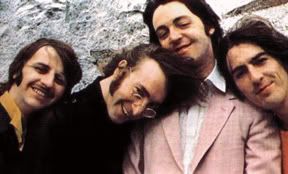
PhotobucketHappy birthday, Richard Starkey, better known as the unstoppable Ringo Starr, who's 70 years of age today. It's hard to pictured that a Beatle is now 70 -- and yes, still hard to believe only two of them survived to senior citizenhood (Sir Paul is a mere 68).

It's a funny thing to be Ringo, of course. Even the most generous assessment would have to place him as the least artistically successful of the four Beatles, although for a brief spell circa 1970 he was actually the biggest-selling solo Beatle. But I don't think anyone would say tunes like "You're Sixteen" and "The No No Song" quite matched up with "My Sweet Lord" or "Imagine." And if it weren't for Pete Best's poor fortune, we'd probably not care about Ringo turning 70 today at all. Really, wasn't he just lucky?

None of that matters, though. The thing about Ringo is that he was the gawky Beatle, the odd Beatle, the charmingly rumpled big-nosed fella who was the underrated drumming engine behind the Beatles sound, the guy who's just been happy to be here all along, the Mr. Billy Shears who sang out of tune.

PhotobucketHe's the everyman Beatle and our eyes among the Fab Four. Even his rather goofy solo work has the amiable Ringo charm to recommend it.

Everyone has a different pick for who their favorite Beatle was, but if you had to choose which one of the Beatles to be? I bet a lot of us would want to be Ringo, the drummer who endures, the guy whose entire life was changed by a band's roster switch. Happy birthday, Mr. Starr.

Friday, February 23, 2007

Movies: The fifth Beatle and the tower of Babel


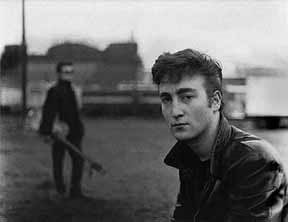
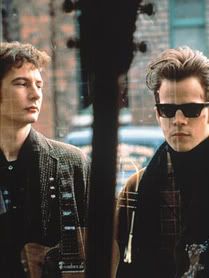
Photobucket - Video and Image Hosting• Been on a bit of a Beatles kick lately (it's required to go through one once a year or so if you often blog about music), and so I revisited the 1994 biopic of their early days, "Backbeat," the other night. Hadn't seen it in years and was surprised by how much I enjoyed anew this take on the Beatles' early Hamburg, pre-fame days, when there were five Beatles and Ringo wasn't in the picture yet. The flick focuses pretty much on John Lennon (Ian Hart) and bass player Stuart Sutcliffe (Stephen Dorff) and their complicated friendship as the struggling Beatles play in assorted Hamburg strip joints and dives trying to get a foothold in the music biz. "Backbeat" has a keen eye for debunking the "moptop cute Beatles" image. It nicely depicts the grime and grit of those early, speed-fueled Beatle years, when they were more punk than pop in their assault, having to play six, seven, eight-hour gigs in something closely resembling indentured servitude. The inhuman work load, terrible living conditions and stress was the fire that forged the Beatles from amicable band into something that would become legendary. "Backbeat" pulses with a cool energy as it romps along these early days. The soundtrack doesn't feature a single Lennon/McCartney tune, focusing on the rock and R&B covers the Beatles made their early name with. "Backbeat" captures the vibe of the early Beatles beautifully (even if it gets a bit too many winks in to the band's famous future - "we're gonna be too big for our own bloody good," Lennon says at one point).

Photobucket - Video and Image HostingMore than a decade after "Backbeat's" release, Ian Hart's performance as the angry, bitter young Lennon is still remarkable to watch – without precisely imitating Lennon, he effortlessly evokes him. Dorff's Sutcliffe is easier to play — because how many people really know what Stuart Sutcliffe was like now? — but it's also a fine acting turn, as is the gorgeous Sheryl Lee of "Twin Peaks" fame as seductive German photographer Astrid Kirchherr. Sutcliffe's sad fate in history is well known - a dispensable fifth bandmate whose bass playing was never spectacular, he was in it for a lark. Stu left the band amicably before they became stars, returning to his first love in art. But then he died not long after at the terribly young age of 21 of a cerebral hemorrhage. He's one of these vaguely haunting figures lurking at the edges of the Beatles' history, whose short life makes him seem mysterious and cool in a doomed way (an attribute "Backbeat" diligently exploits). Yet by age 21, the man was a very promising young artist, had a glorious adventure in Germany and fell in love with a girl, and became a Beatle. There are worse epitaphs.

(Photo of Lennon and Sutcliffe (C) Astrid Kirchherr. A marvelous selection of her iconic Beatles shots can be seen at this site.)

• So last weekend I had a Peter-free day and took in "Babel," in an effort to see more than one of the best picture nominees before this Sunday's Oscars. It was a quality flick, but lacking the focus to make it worthy of being best picture, in my mind. It's like a globalized version of "Crash" – bad things happening to insulated or ignorant folks for two hours in loosely intertwining stories, told with skill and some fine acting, but something crucial missing in the mix. The main problem I had with "Babel" is that I could feel the writer's hand in almost every scene – you shouldn't be able to see the strings that easily on the puppets. Little of it felt unforced, save perhaps the Japanese girl's storyline, which almost belonged in an entirely different movie. Brad Pitt is excellent in a supporting role, and there's several incredibly tense, powerfully presented sequences throughout this harrowing movie. It's not a terrible movie by any means, but being nominated for several Oscars including Best Picture gets your expectations pretty high. Director Alejandro Iñárritu's crazy-quilt storytelling style seems to be a hit with many critics, but I find it often simplistic. (His last movie, "21 Grams," was melodramatic and insincere.) "Babel" feels like a picture aching to impress you with its profound insight.

• Good luck to our friend Erin and her partner Val, who have left Auckland on several months of global travel before ending up in Vancouver, Canada, and are blogging about their adventures here. Go read - they're way more exciting than my blog!

Tuesday, November 21, 2006

Music: The "new" Beatles CD, "Love"


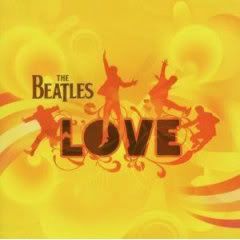
Photobucket - Video and Image HostingAre The Beatles holy writ? Is remixing and "mashing up" their original tunes heresy? Some Beatle-fans are looking at the new release of The Beatles "Love" CD with trepidation. The surviving two Beatles had little to do with it other than approving it, and it was mostly assembled by Giles Martin, the son of legendary Beatles producer George Martin, with some consultation from his father. Commissioned as the soundtrack to a Cirque du Soleil stage show, it's being billed as the first authorized Beatles remix project.

Purists shouldn't fear — "Love" hardly destroys the Beatles' songs. But in the end, nice as it is, "Love" is basically a slick gimmick lacking any real message besides, "doesn't it sound cool that we can do this?" Perhaps you just had to be at the stage show.

First off, the songs on "Love" do sound bloody wonderful, crisply reworked and remastered (there's also an even spiffier audio DVD mix of the album with 5.1 surround sound and stereo available, which I haven't heard). There's a fullness to it that makes the sounds leap from the speakers. When "Revolution" kicks in, the proto-metal snarl of guitars and screams will just about knock your head off with its clarity. It's miles above any other previous Beatles CD releases.

Photobucket - Video and Image HostingBut most of the mashups lack any real potency. It's a kick, at first, to hear shreds of the assault of "I Want You" splashing together with fragments of "Being For The Benefit of Mr. Kite," or to hear "Sun King" turned eerily inside-out for the backwards track "Gnik Nus." Some tracks are gorgeous, like the "Strawberry Fields Forever" that blends stripped-down demo into a slowly building crescendo, tossing in elements of "Penny Lane," "Piggies" and "Hello Goodbye."

But too many others are like "Eleanor Rigby," or "A Day In The Life," nearly the same as the old version, or a failure like "Octopus's Garden," grafted with an awful patch from "Goodnight" that turns it into a lounge track. "While My Guitar Gently Weeps" features a new elegant and subdued string score background added by Sir George Martin himself, but as much as I admire Martin's work, "Weeps" version 2.0 has more than a whiff of Musak to it.

I really was hoping "Love" would go further. If anything, it's too reverent, too conservative in its approach.

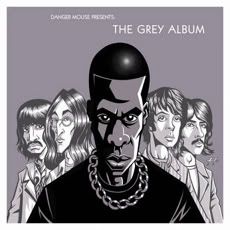
Photobucket - Video and Image HostingAnd as many music buffs will tell you, this is hardly the first time something like this has been attempted. There's the famous Grey Album, an illegal bootleg DJ Danger Mouse (now of Gnarls Barkley) did back in 2004 surgically lifting vocals from Jay-Z's Black Album and adding a flurry of chopped-up bits from The Beatles White Album as backing tracks. A whole parade of similar underground "mashups" followed, from "The Black and Blue Album" (Jay-Z and Weezer) to the "Slack Album" (Jay-Z and Pavement).

While few of these were particularly interesting except as experiments, some were remarkable recreations. The Grey Album crushed The Beatles down to their component DNA, pulverizing song fragments until they were utterly remade – which might offend purists, but resulted in some dazzlingly creative listening. Other Internet mixers have put their own stamp on The Beatles' raw material. (There's a nifty complete reworking of "Revolver" floating around on the Internet using samples from a variety of artists that is quite playful fun.)

And that might be the singular problem with "Love" for me – it's just not revolutionary enough, when we've been shown there's so much more you can do. Adding a drum flourish from "The End" to "Get Back" doesn't fundamentally make you view the song in a new light. Ideally, a mashup shows you a facet of the song you've never imagined, like a prism in the sun, rather than just evoking memories of the original tunes.

"Love" doesn't desecrate what the Beatles did; really, the noble intent is to celebrate their talents. But it also really adds nothing new to the legend, other than showing us how fine the Beatles catalog will sound whenever it's all completely remastered to the highest potential. That makes it feel like a movie trailer, a tease for the extra cash we Beatle-fans will be asked to shell out in 2008 or whenever. I can't imagine repeat listening being very rewarding, unlike the original albums.

"Love" is a clip-and-save kaleidoscope of greatest hits and a novel stage show soundtrack, but little more than that in the long run.

Tuesday, May 25, 2004

Continuing the all-Beatles, all the time theme I've got going here lately, and also because I'm too darned lazy to write something new today, here's a column from the vaults: My Dec. 6, 2001 column back when I was editor of the Sierra Sun in Truckee, Calif., with my memories of George Harrison.

Our Sweet George; 1943-2001
I was a few years away from being born when the Beatles broke up.
So one wouldn't have pegged me as being in their target audience, perhaps, but in a backwards kind of way, it was actually the late George Harrison who pointed me toward the majesty of the Beatles.
Back in 1987, I was a fidgety high school freshman bombarded by synth-pop music such as Wham!, Duran Duran and Depeche Mode. Then, for some weird reason, MTV and the radio started playing this weird tune by this OLD guy named George Harrison, "Got My Mind Set On You." The so-lame-it's-cool video, with Harrison sitting in a country lodge hunting den strumming a guitar, was in heavy rotation.
"Got My Mind Set On You" was an oddly catchy ditty, and I ended up getting a copy of the cassette (yep, it was the '80s) somewhere along the way. That latest Harrison album, "Cloud Nine," was a lush and elegant collection of catchy pop tunes.
I vaguely knew that he was a "Beatle" once, but while I was of course aware of the Beatles in the way that any semi-sentient life form would be, I didn't know too much about them. After listening to "Cloud Nine" over and over with increasing appreciation, I figured it might be good to find out more about this guy Harrison and his history.
The first Beatles album I bought was the one everyone tells you to get, "Sgt. Pepper's Lonely Hearts Club Band." From there it was off to the races, and today I own pretty much every Beatles CD and a great deal of their solo albums. In my own conceited little way, I've always felt that if you can't appreciate the Beatles, you're missing something fine and wonderful in your life. The Beatles helped crack open a world of music to me, and paved the way for me to discover artists from Peter Gabriel to Guided By Voices, from R.E.M. to the Velvet Underground.
And I wasn't even born when they broke up.
Harrison always came in third behind Lennon and McCartney in the Beatles' popularity race, and even goofy ol' Ringo tended to get more press than George did. But Harrison arguably was the backbone to the Beatles sound – as their lead guitarist, he put the "pop" into some of Lennon and McCartney's finest songs, unifying their very disparate lyrical visions with one voice, and even throwing in some classics of his own along the way.
George was less the "quiet" Beatle than he was the inscrutable one. A deeply religious man, he chose to get off the fame merry-go-round after the Beatles broke up, only releasing a dozen or so albums in the 30-plus years since – and what would be his last major release, "Cloud Nine," came out in 1987, 14 years ago now.
George Harrison's death isn't as savage and shocking as John Lennon's assassination, and thank God for that because we've all had enough tragedy lately on this earth, haven't we?
I'm a little bit sad that George Harrison is no longer with us, but if anyone was prepared for death, he was. He wrote a song back in the '70s from "All Things Must Pass" called "The Art Of Dying," where he wrote this fine little line:
"…As nothing in this life that I've been trying
Can equal or surpass the art of dying
Do you believe me?"
Fifty-eight is neither quite old enough or too young to die at, but even if he was cheated out of his later years by cancer, by any measure George Harrison led a fine, full life, and one we can all be grateful for.

Here's a primer of some of George Harrison's best, if you happen to not know what all the fuss is about:
Ten of George's finest moments, chronologically
1. "Norwegian Wood" - Although Lennon sang the lead, it's the eye-opening twang of George's sitar in this song from "Rubber Soul" that really marked the Beatles' metamorphosis from teen pop stars to something far more.
2. "Taxman" - This angry, bleak song Harrison penned for "Revolver" was one of the Beatles' only "socially relevant" tunes, taking on England's stratospherically high tax rates.
3. "Within You, Without You" - Probably the best example of George's trippy Hindu mysticism as he brought it to the Beatles, sacred and secular at the same time.
4. "While My Guitar Gently Weeps" - You saw versions of this title used in countless headlines last week mourning Harrison's death; that's because it's probably the finest song he ever wrote, and one of the best Beatles tunes ever.
5. "Here Comes The Sun" - Charming as a child's lullaby, this song from "Abbey Road" pulls off the tricky business of being sweet and innocent without seeming cloying.
6. "My Sweet Lord" - Forget the misguided plagiarism lawsuit this song inspired, claiming Harrison "unconsciously plagiarized" the melody from the cheesy Chiffons hit "He's So Fine." Just relax and listen to one of the most forthrightly religious mainstream rock songs ever recorded, a tune that works for almost any faith.
7. "Got My Mind Set On You" - Harrison's remake of a '50s rockabilly song is catchy and fun, with no higher goal than just making you tap your toes and hum along.
8. "That's What It Takes" - This sweet tune from "Cloud Nine" has always summed up to me what Harrison was – a man full of faith and optimism, always struggling with his inner cynic and trying to reach a higher plane.
9. "Handle Me With Care" - Harrison's 1989 collaboration with Bob Dylan, Roy Orbison, Tom Petty and Jeff Lynne as the Traveling Wilburys is an underrated treasure. This song really captures Harrison's sheer joy of music-making and, you'd be hard-pressed to find more music legends cutting loose on one record.
10. "Free As A Bird" - From the 1995 Beatles anthology, this tune fusing a lost Lennon demo with new input from the surviving Beatles is a little eerie, a lot nostalgic, but hardly the Beatles at their best. Yet the sweet chime of Harrison's guitar at the very beginning and throughout the song is a perfect example of how a few chords can sum up an entire band – that sound "is" The Beatles. How sweet it was.