Showing posts with label David Bowie. Show all posts

Sunday, January 8, 2012

Happy 65th birthday, David Bowie!

...One thing that happens as you get older is your idols get older, too. It's hard to believe David Bowie is of retirement age today - even though he's been semi-retired since 2004 or so. I've written about Bowie many a time before on this blog. It's fair to say I'm a mega-fan, of pretty much everything from "Space Oddity" on up to "Bring Me The Disco King." Heck, I even have a soft spot for the Tin Machine era.

His "retirement" after his last studio album, 2003's "Reality," was a surprise - no melodramatic goodbye announcement or anything, but a slow fade away. While Bowie's given us enough entertainment for several lifetimes, the selfish fan in me still hopes he might come out for one last hurrah sometime - 65 isn't quite ready for the nursing home just yet.

One of my bigger musical regrets is not seeing Bowie when he performed in Portland, Oregon in 2004 on what would turn out to be his last major tour. I foolishly thought I'd get another chance to see him, and little Peter was less than 2 months old and cash was thin on the ground. But man, now I'm thinking I might've missed my one chance to see Bowie live. I've seen most of the other musicians on my "concert bucket list" but Bowie has eluded me.

If you held a gun to my head and asked me to choose between my top three musicians of all time - Bowie, Dylan and Elvis Costello - I figure I'd have to go with Bowie, whose sheer theatrical inventiveness pushes him slightly over Misters Dylan and Costello for me. Happy 65th birthday, Mr. David Jones, wherever you are - and thanks for all the memories.


Don't let me know when you're opening the door
Close me in the dark, let me disappear
Soon there'll be nothing left of me
Nothing left to release

- "Bring Me The Disco King," the last lyrics on the last album David Bowie has released to date.

Friday, August 27, 2010

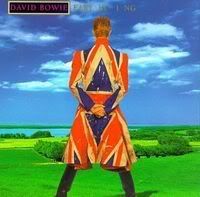
Nik's unheralded albums #1: David Bowie, "Earthling."

There's albums that are loved by someone, but don't quite become "classics" to the mainstream. Everyone knows "Highway 61 Revisited" when they think of Bob Dylan, but who sticks up for, say, "Infidels"? Here's an occasional series that looks at lesser-regarded albums that I really dig.

David Bowie, "Earthling" (1997)*

Photobucket1997's album "Earthling" comes at an interesting time for David Bowie; I call it his "midlife crisis" album, as it came out the same year he turned 50. Heavily influenced by drum 'n' bass dance music, "jungle" techno and industrial rock, it follows the same path started in 1995's "Outside," a Goth cyber-murder concept album that really began Bowie's modern critical revival after Tin Machine and various subpar '80s and '90s efforts. "Earthling" is less heralded by fans and critics, but it's one of my top 5 Bowie albums.

A lot of that is due to the time I discovered it; most great records evoke something in our lives, have some personal relationship to us beyond mere melody. For me, "Earthling" came along when I'd just moved rather haphazardly across the country, from post-college Mississippi to my old homeland of California. I moved without a real plan or job, and after a few months of bumming about and relying on the kindness of old friends, ended up working at a tiny little paper south of Sacramento, a kind of nowheresville with endless valley landscapes. Didn't know where I'd go next, wondering if I'd screwed up by leaving all my old pals in the South, etc.

So "Earthling" was the soundtrack for much of fall '97 and early '98, as I kind of drifted in a job that was OK in a town where everybody my age seemed to have three kids and work at Kmart. (Obviously, life got better, my future wife Avril emigrated to the U.S. and we moved up to Lake Tahoe in summer '98.) "Earthling" is a really anxious, fretful Bowie album, one that kind of assaults you with rippling beats and distorted guitars. It's the loudest of all his albums, and it definitely feels a bit like a 50-year-old trying to sound cool. Yet it works for me to this day.

PhotobucketThe lead track, "Little Wonder," is all skittering blips and screeching guitars, Bowie chattering away like a man on the edge of a breakdown. Lyrics in general aren't the focus of this album, which shows a lot of influence from William Burroughs' "cut-up" writing method. Several tracks, like "Looking for Satellites" or "Law (Earthling on Fire)," are abstractions set to thumping, circling dance music, meant to create mood more than anything. A song like "Seven Years in Tibet," with a compulsive sway, roaring chorus and snippets of Mandarin, is as experimental in its way as any song on "Low." One of my personal favorites on "Earthling" is "Dead Man Walking," a rave-up defiant rebuttal to aging, colored with Bowie's trademark nostalgia and wistfulness, but with a beat you can dance to. Another sterling track is "I'm Afraid Of Americans," which could nearly be a novelty song if it weren't for the very real angst Bowie brings to the tune, wailing lines like "I'm afraid of Americans / I'm afraid of the world / I'm afraid I can't help it." You believe him. Yet my most replayed song on "Earthling" is probably "The Last Thing You Should Do," all raging at the darkness and jittery fear. It's claustrophobic but cathartic at the same time, and the kind of song many techno bands are striving for and miss much of the time. I listened to it a lot in the fall of 1997, wondering who I was and who I'd be a year from then.

Like I said, fear runs through the tunes of "Earthling," fear of death, losing power, potency and the world. "Earthling" is very different from most of Bowie's catalog, with the exception of its predecessor "Outside." His next album, "hours..." heralded a move toward a gentler, more introspective phase. Despite appropriating the sound of bands like Chemical Brothers and Nine Inch Nails, Bowie still managed to be unmistakably himself. "Earthling" is one of his strongest albums in a lifetime full of peaks.

*This a repost and a bit of a reworking of a post from way back in 2005; I've got a few other albums in this vein that I plan to look at in coming weeks.

Wednesday, September 30, 2009

...Which is why I will never believe anything on the Internet ever again.

PhotobucketSo for about five minutes there, it seemed David Bowie was going to be playing New Zealand and Australia's Big Day Out festival next year, and all was good in the world. I knew it was a fact because the Internet told me so. Why, Stuff said he was "expected to be announced" as the headliner for the music festival. Of course, it was bollocks -- no Bowie in the final Big Day Out lineup, sigh. I'm actually a bit relieved as while I did have a fantastic time in 2008 and in 2009 at the Big Day Out, I wasn't really planning on going a third year in a row unless the lineup dazzled my innards. This year's crew -- Muse, Lily Allen, Kasabian, Mars Volta, Dizzee Rascal -- well, it just makes me actually feel my age a bit as the only one I'm even slightly familiar with is Lily Allen. Anyway, that's about $300 we can save for more grown-up pursuits. Like seeing The Pixies when they come here in March! But y'know, it was amazing to see how quickly this Bowie rumour became fact on the Internets as so many others do these days. Even though Bowie hasn't gone on tour or released an album in nearly 6 years, apparently it was a given that he was going to be making his big comeback at age 62 in New Zealand. The meme even actually overtook the actual lineup as the festival organiser had to make a statement about the non-appearance of Bowie.
* Had to steal the art above from here. Which is a real website.

• I heartily recommend Nick Hornby's latest novel "Juliet, Naked," which is a nice return to his "High Fidelity/About A Boy" form after a few lesser books. "Juliet, Naked" is almost "High Fidelity 2" in how it digs into that strange world of music obsessives (um, not that I know anything about that), spinning a tale of fixated fans, reclusive musicians and lovelorn museum curators that's a real brisk, good-hearted and enjoyable read. I like how Hornby integrates online fan communities and even Wikipedia into his story without it seeming like a pandering attempt to be "hip," and his portrayal of has-been '80s musican Tucker Crowe is one of his strongest characters to date. If you haven't checked out Hornby's books in a while, this is one to go to.

• Also a fine if incredibly trippy read is "Batman: The Black Casebook," a way-out collection of utterly bizarre 1950s Batman stories reprinted to tie in with writer Grant Morrison's recent "Batman R.I.P." storyline, which was heavily inspired by this. I know everyone's into Batman the Dark Knight who stalks Gotham City and never smiles, and I like that guy too, but I have to admit I really have a soft spot for the incredibly strange Batman stories of the 1950s, when Bats would be as likely to be fighting aliens, go back in time or hire a dog to be his crimefighting companion. PhotobucketThis "Black Casebook" is a very affordable survey of the era, which hasn't really been explored in reprints as much as it should be – apparently it reminds too many of the time when Batman was, well, a bit goofy. But Grant Morrison in his excellent introduction looks at these stories with an eye for just how odd and unsettling they are – such as when Batman stumbles into the parallel dimension of Zur-En-Arrh and meets an alternate, bizarrely coloured Batman, and the story has the passionate madness of a fever dream. There's also the introduction of magical elf Bat-Mite (who rapidly became annoying, but was indeed a funny little fellow in his first appearance), the "Batmen of All Nations" (meet the Italian Batman, the Legionary!), and much more. What I think I love the most about this era of comics is that anything could happen without the menace of "continuity" without pandering to a small and demanding fan community. Whatever worked -- if it meant turning Batman and Robin into leaves or zebras. The surreal appeal of these stories is like a Salvador DalĂ­ painting. "The Black Casebook" is terrific nostalgic fun and a nice tonic for endless "gritty" stories featuring the Joker slaughtering people. Bring on "Black Casebook II" and reprint more of these lost gems.

Saturday, August 15, 2009

Week of music lists: 7 great albums from 1971

Last time we got modern, today we get retro again as Week of Music Lists continues with albums I dig that came out all the way back 38 (urk) years ago:

7 GREAT ALBUMS I OWN RELEASED THE YEAR I WAS BORN, WHICH WAS 1971


Photobucket1. "What's Going On" by Marvin Gaye - Ah, Marvin. We don't need to escalate.
2. "Who's Next" by The Who - Arguably, their peak, not quite as full of filler as some of their concept rock operas but more assured than their earlier albums.
3. "There's A Riot Goin On" by Sly and the Family Stone - Nowhere near as exuberant as their earlier singles, but still a classic piece of druggy funk.
4. "Sticky Fingers" by The Rolling Stones - The Stones at their peak.
5. "IV" by Led Zeppelin, or Zoso or whatever you wish to call it - As noted in the comments to Mandy, I'm not a giant obsessive Led Zep fan, but this album pretty much sums up everything great about the band. Rawk!
Photobucket6. "Hunky Dory" by David Bowie - Not his single greatest album, perhaps, but where the greatness begins.
7. "Master of Reality" by Black Sabbath - The riff for "Sweet Leaf" makes me want to be 15 forever, but without all the angst and zits.

Tuesday, January 8, 2008

30 Days of Bloggery: Happy Birthday Bowie!


...Ground control to Major Tom, the man himself is 61 years old today! Ye gods. Bowie is a senior citizen. I hope he releases an album this year, his last, Reality, was nearly 5 years ago now and I think he's still got a little spark in him yet.

In honor, here's a handful of classic Bowie videos.


Bowie, "Heroes," 1977


Bowie, "Queen Bitch," live on the BBC


Bowie and the Foo Fighters, 1997, "Hallo Spaceboy," absolutely thrashing version of this tune.

Long live the Ziggy!

Monday, January 8, 2007

Happy 60th Birthday, Mr. Bowie
(and my top 25 Bowie songs of all time)

Photobucket - Video and Image Hosting
Good lord, yes, today, Monday, is the day David Jones, aka The Thin White Duke, aka Ziggy Stardust, turns 60 years old. David Bowie at 60, who would've imagined it? For years now, Bowie has perched high at the top of my favorite musical artists list.

I first got into Bowie in the hydrogen-peroxide hairdo era of "Let's Dance" and "China Girl," then sometime around 1988 got his "Changesbowie" greatest hits cassette, which blew my mind like few albums since (spanning from the dreamy nihilism of "Space Oddity" to the top-40 bop of "Blue Jean" on one slim tape). To varying degrees of obsession, Bowie's been tops of my pops ever since. Today I've got every Bowie album of note and a healthy stack of bootlegs to add up to more than 50 CDs, far more than any other artist in my CD closet.

I think what I demand most from a musician is change, is the ability to come up with new angles and new ways of showing us the world. "Space Oddity" and "Warszawa" and "Little Wonder" barely sound like they're from the same planet, let alone by the same man. Bowie is the king of that chameleon mutation.
Photobucket - Video and Image HostingI decided to mark Mr. Bowie's 60th by listing my Top 25 David Bowie Songs of All Time, "High Fidelity" style. In flicking through the Bowie CDs in my collection, it was like finding familiar old friends again. My final tally is a scattered list, some popular faves, some lesser-known tracks. I've long settled on Bowie's "Berlin" era, roughly 1976-1980, as my favorite part of his career, though I've also got a soft spot for the "electronica" Bowie comeback of the late 1990s' "Outside" and "Earthling" albums. His earliest hippie-dippy stuff never did much for me ("The Laughing Gnome"? Egad), and even "Hunky Dory" I have to be in the right frame of mind to dig. But the sprawling diversity and creativity of Bowie's nearly 40 years of music still amazes me, and every new Bowie album remains worth buying to me.

Happy birthday, Ziggy!

1. Space Oddity (Space Oddity, 1969) - Spaced-out and lost, the song that inspired everyone from Yo La Tengo to Wilco.
2. Quicksand (Hunky Dory, 1971) - The best of Bowie's early "ambiguously gay crooner" phase, where his reach often exceeded his grasp. This song is pretentious, but there's a real pathos lurking beneath the wordplay.
3. Ziggy Stardust (The Rise And Fall of Ziggy Stardust, 1972) - Thirty-plus years on, there hasn't been a better song about being in a rock 'n' roll band.
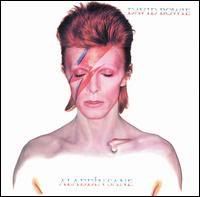
Photobucket - Video and Image Hosting4. Lady Stardust (The Rise And Fall of Ziggy Stardust, 1972) - Gorgeously lonely cabaret.
5. Waiting For The Man (Bowie at the Beeb, 2000) - Recorded in 1972 for the BBC, this sleazy, grooved-out cover of the Velvet Underground tune actually bests the original in my humble view.
6. Diamond Dogs (Diamond Dogs, 1974) – Raunchy and spastic, the last sputter of Bowie's "Ziggy" era of decadent glam rock; but what a farewell!
7. Young Americans (Young Americans, 1975) - Bowie's plastic soul phase, and an ironic anthem that still feels kind of fresh and electric.
Photobucket - Video and Image Hosting8. Station To Station (Station To Station, 1976) - Ten minutes of soaring rise and fall, apocalypse and redemption, Bowie's single most epic track.
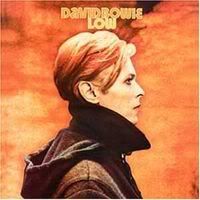
9. Sound And Vision (Low, 1977) - A sweetly sinister ode to the power of music.
10. Warszawa (Low, 1977) – The best encapsulation of the still-futuristic instrumentals Bowie and Brian Eno created; an instrumental glimpse into a fragmented, eerie parallel world.
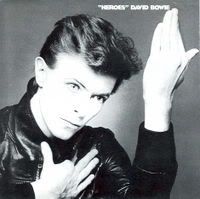
11. "Heroes" ("Heroes," 1977) – The finest of Bowie's "dreamer" songs, about love that just won't last, and a well-deserved classic.
12. Look Back In Anger (Lodger, 1979) — Gloom-ridden, hook-filled doomsday rock, about the approach of death or something stranger still?
13. Scary Monsters (And Super Creeps) (Scary Monsters, 1980) - If I had to pick a single Bowie album as my favorite, 1980's album of this title would likely be it, covered in jittery angst and with a melancholy danceable heart.
14. Teenage Wildlife (Scary Monsters, 1980) – A yearning, murky yet urgent anthem.
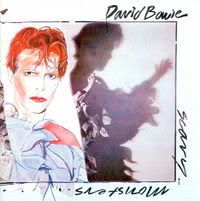
Photobucket - Video and Image Hosting15. Ashes To Ashes (Scary Monsters, 1980) – Goodbye to the past, but what lies ahead?
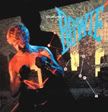
16. Let's Dance (Let's Dance, 1983) – "Sell out" or utterly perfect pop escapism? I favor the latter.
17. China Girl (Let's Dance, 1983) —Evocative of the foreign shores where I'd one day end up living. Its slightly patronizing colonialism still hints at the mysteries of the wider world.
18. As The World Falls Down ("Labyrinth" soundtrack, 1987) - Ultra-cheeseball choice, but I've a soft spot for the Bowie/Jim Henson fantasy collaboration, and this one fairy-tale romance song by Bowie as the Goblin King always stuck with me, even when I saw "Labyrinth" in the theater three times at age 15.
19. Run (Tin Machine, 1990) – Everyone maligns Bowie's Tin Machine phase, but I still thought there were some fine hard-rock tracks in amongst the filler. This tune always puts me in mind of the summer of 1990.
20. Miracle Goodnight (Black Tie White Noise, 1993) – "Black Tie" is a little too fluffy an album for me, but the boppy bliss of this Bowie-as-lothario tune always gets me to smile.
21. The Buddha of Suburbia (Buddha of Suburbia soundtrack, 1993) – Lost through much of the late 1980s and 1990s, it took a BBC soundtrack for Bowie to start finding his muse again; this ode to a life long gone is one of his most heartfelt ballads.
Photobucket - Video and Image Hosting22. Hallo Spaceboy (Outside, 1995) - Bowie goes industrial in this chaotic dance tune, backed by a killer drumbeat. From the muddled yet fierce concept album "Outside," which boasted some of Bowie's strongest music in years.
23. The Heart's Filthy Lesson (Outside, 1995) - Another killer "Outside" tune, slinky and sinuous; the disturbing video makes Bowie seem truly dangerous for the first time in years.
24. The Last Thing You Should Do (Earthling, 1997) - Bowie's drum & bass experiments continue, with this seething, staticky explosion of a song, like a distant cousin to the angst of "Scary Monsters."
25. Bring Me The Disco King (Reality, 2003) - Bittersweet and nostalgic, a nervous cousin to "Station To Station," looking back at the years and as naked emotionally as anything Bowie's ever done.

Saturday, August 5, 2006

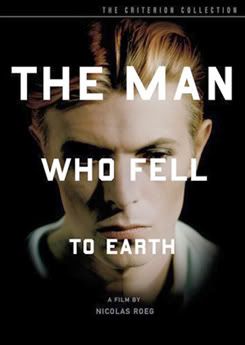
MOVIES: 'The Man Who Fell To Earth'


Photobucket - Video and Image HostingAs regular readers know, I'm cuckoo for David Bowie. Yet perhaps his best-known movie, 1976's "The Man Who Fell To Earth," was always a kind of enigma to me. It took me until maybe the third or fourth time watching this strange, hypnotic curio to really start appreciating it. I picked up the fantastic new Criterion Collection 2-DVD set of it recently and watched it with the commentary featuring Bowie, director Nick Roeg and co-star Buck Henry. As with the best commentaries, I was left with a whole new appreciation for what they were trying to do here.

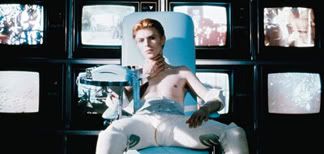
If you've never seen it, "The Man Who Fell To Earth" is a trippy quasi-science fiction film. It came out shortly before "Star Wars," but it's almost completely the opposite kind of movie. In a nutshell, Bowie is Thomas Newton, an alien from a dying world who comes to Earth to find a way to save his family. But although he quickly becomes a millionaire selling alien technology patents, Newton soon loses his grip with the temptations of humanity's sins. Drugs, women and violence begin to corrupt this gentle soul. Ultimately, he ends up losing his freedom when his true identity is discovered.
Photobucket - Video and Image Hosting
"The Man Who Fell To Earth" isn't an easy movie to watch – it's a strange impressionistic non-narrative, hallucinatory and yet vividly real. Newton can be seen as an angel losing his innocence, a fool getting his just deserts or an artist corrupted by reality. Roeg makes his story elliptical, hard to follow at points. It's far less about narrative than it is about sensation, the eerie loneliness in the core of life. Certain scenes seem more added for shock value than adding anything to the story. Yet the whole is a haunting vision. Roeg avoids sci-fi clichĂ©s – there's a few surreal glimpses at Newton's homeworld and life there, but Roeg more determined to show us how alien Earth really is through Newton's eyes. He makes us feel like Newton, alone and overwhelmed by strangeness.
Photobucket - Video and Image Hosting
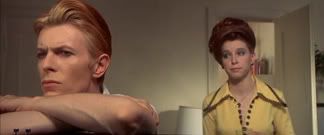
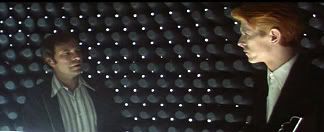
Bowie has dabbled in acting on and off over the years, but "The Man Who Fell To Earth" remains his one true masterpiece. Bowie's basically playing a twisted mirror vision of himself – he was whacked out on coke at the time, dazzled by superstardom and nearing the collapse that would lead to the brilliance of his "Berlin" period. Yet he's never been more beautiful than he is here, fragile and utterly charismatic as Newton moves from ingenue to bitter outcast. In supporting roles as Newton's "temptations," Candy Clark is terrific as a woman who moves from hotel maid to Bowie's companion, ending up shattered by him. Rip Torn grounds the movie in reality as an acerbic, cynical professor who ends up sucked into Newton's world – and ultimately betraying him.
Photobucket - Video and Image Hosting
One thing that's off-putting when you first view Roeg's film is his handling of the passage of time. Roeg jumps abruptly back and forth in the narrative, and years can pass in a single transition. Bowie's Newton is ageless, immortal, but as the film passes you start to see other characters age. Roeg views time as a fluid ocean, and his approach colors how we see the film. Like much 1970s film, it's also far more open about sexuality than today's movies – Roeg contrasts how we view sex and how Newton sees it to a truly disorienting effect. The movie and its fashions are quite dated, of course, but I still find it timeless in the same way that say, Woody Allen's "Annie Hall" is – bell-bottoms aside, it remains a true snapshot of the human condition.

This Criterion DVD set is their typically comprehensive work – besides the beautifully remastered version of the film itself (the colors "pop" and the elegant, alienating cinematography sparkles), you've got special features galore - interviews with most of the principals, writers and more. In a nice bonus, there's also a copy of Walter Tevis' original 1963 novel. (Which I haven't had a chance to read yet – oddly, though, the late Tevis also wrote the book that the movie "The Hustler" is based on. Pool and aliens. Cool.)

"The Man Who Fell To Earth" is one of those rare movies I can return to every few years and get something totally different out of it each time. In that way, even though it's 30 years old, it remains ahead of its time.

Tuesday, May 16, 2006

MUSIC: The Perfect Songs, Part VI


Man, it's been a while since I did this, eh? Well, anyway, this is the ongoing list of the songs I think are as close to perfect as a song can be – songs I never tire of, no matter how many times I hear them, songs that put it all together and spit it out in a sonic stew. As always, it's in the eyes of the beholder, caveat emptor, warranty not valid in Minnesota, etc.
The latest three:

Photobucket - Video and Image Hosting 16. "Let's Dance," David Bowie. Yeah, for hardcore Bowie-philes like myself, this pop hit is often called where "it all went wrong," leading to his mediocre slide through the 1980s and early 1990s. Bowie "sold out," "went pop," had the biggest hit of his career, and wouldn't Ziggy Stardust be ashamed? Nonsense. This is one of the finest pure pop songs you'll ever hear, love and lust given a Bowie skew. It may be romantic clichĂ©s, but man – does Bowie ever sell it all. Listen to this song like you haven't heard it a million times and you'll be astonished. There's that slinky horn-pulse riff, the slashing guitar licks of Stevie Ray Vaughn, the debauched club bassline from producer Nile Rodgers, and lording over it all, Bowie's anguished, overwrought vocals, wringing every syllable out of the lyrics. Bowie puts a slightly dark, haunted spin on it all – "let's dance / for fear tonight is all." Serious moonlight" – seriously, what a turn of phrase. It's no sell-out. Rather, it's Bowie showing he can do Top 40 pop as well as anyone in the business if he wants. The song's available in multiple versions – a nearly 7 1/2 minute jam on the "Let's Dance" CD, some quirky remixes on the rare "Club Bowie" CD, and a particularly strong "slowed-down" version Bowie did live for a while, captured on the "Bowie at the Beeb" CD set bonus disc. "If you say run, I'll run with you."

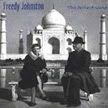
Photobucket - Video and Image Hosting17. "Bad Reputation," Freedy Johnston. Freedy is a never-quite-was, a tremendously talented singer/songwriter from the early 1990s who had a passionate, quirky vision, who crafted glittering little songs like Raymond Carver short stories. "Bad Reputation" is perhaps his only real "hit," a minor success from the summer of 1994, when I discovered Freedy. It's a gorgeous, bittersweet lament, a tale of missed chances and too-short perfect moments, just a man singing his sad sad song. He sees the girl in a crowd, the girl he once knew better than anyone, and before he can react she melts away into the faces. Like all the best songs, it's heartache made palatable by a beautiful turn of phrase, a haunting melody. Yet Freedy never quite surpassed that song. He had two A+ albums – 1992's "Can You Fly" and 1994's "This Perfect World" (which "Bad Reputation" came from); then a half-great album, "Never Home," followed by two increasingly bland, mediocre albums and nothing since 2001 or so. But for a couple albums, this man had the voice of an angel and the stories of a journeyman. Hunt them down. "I know I got a bad reputation / and it isn't just talk, talk, talk."

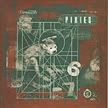
Photobucket - Video and Image Hosting 18. "Monkey Gone To Heaven," The Pixies. Crunching down from the ionosphere, this song's just here visiting from another planet – huge sparkling guitar riffs, Black Francis's cool and self-assured lyrics, Kim Deal's sweet floating backup mantra. It's a song where all the pieces just come together – Black's deadpan voice, Deal's throbbing bass, David Loverling's steady drumbeat, "rock me Joe" Santiago's ace guitar lines propelling the song. It's not the most representative Pixies song ever, objectively – "Debaser" is more pure anarchy, "Gouge Away" more sinister, "Here Comes Your Man" cuter, "Gigantic" sexier – but most fans will say it's one of their best. The lyrics have a kind of jaded ease that'll make teenage potheads shiver at how "deep" they are, yet even stone-cold sober they have a kind of universal echo – "If man is five / then the devil is six." There's an unfathomable sadness at the core of "Monkey" that makes this song cut hard and fast, a buildup and explosion that makes the song never seem old to me. And you get that Black Francis scream at the end. What more does a Pixies fan need? Two minutes, 58 seconds of pure ecstasy. "…Then God is seven / then God is seven / then God is seven."

Tuesday, January 10, 2006

Image hosted by Photobucket.com
Don't look at me like that. I swear I didn't mean to forget that yesterday was David Bowie's 59th birthday. But it was Sunday, and I was y'know, hanging out with toddlers and lying on the couch and such. I hereby abdicate my title of dedicated BowieGeek and dedicate myself to having a thoroughly boring life. ...Anyway, sorry, Dave, hope it was a good one...

And yes, I'm a tremendous nerd.

Wednesday, November 16, 2005

MUSIC: Everything you ever wanted to know
about David Bowie's "Low" but were afraid to ask


"Writing about music is like dancing about architecture," Elvis Costello famously once said, but heck, even if it's chasing ghosts, I love reading solid rock criticism. Done well, a writer can give you a new view of an old tune, or turn you on to something you've never heard before.

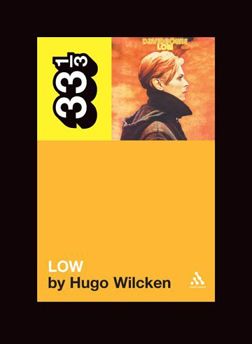
The 33 1/3 series by Continuum Books takes music writing and distills it down to its essence. They're short chapbooks devoted to analyzing the story of a single great album, through history, interviews, essays or even fiction. They're tiny, just under 5 x 7 inches and about 125 pages each volume, and they're oh so darned cute. The series so far has tackled everything from Springsteen to the Velvet Underground to Joy Division to DJ Shadow to The Beatles. The series' free-form nature can sometimes lead to indulgent intellectual meandering, but most of the books I've read so far have been tight, informative and insightful. (A complete list, including some future titles and proposed ones, can be found right here)

Image hosted by Photobucket.comAnyway, up in Portland last weekend I picked up one of the newest 33 1/3 volumes, a look at David Bowie's "Low" by writer Hugo Wilcken. Soon as I saw that "Low" was now part of this series, I didn't hesitate to grab that puppy off the shelf. Readers of this blog know I'm a big-time Bowiephile, and "Low," Bowie's 1977 landmark, is right near the top of my favorite Bowie albums. In its glacial cool and soulful angst, "Low" never gets old to me. Recorded just shy of 30 years ago, it's still futuristic and strange, combining dreamlike pop with machine-like instrumentals, punk flavors, ambient drift and hypnotic rhythms, and sparse lyrics following the drifting of a lost soul. Perhaps the best quote I've ever read about "Low" comes from Bowie himself in Wilcken's book — it captures "a sense of yearning for a future that we all knew would never come to pass."

In the "Low" volume, Wilcken does a very solid job of establishing the context from which "Low" sprung — Bowie's drug-addled, near-catatonic mental state at the outset of recording, his family history of mental illness, collaborators like Brian Eno and Tony Visconti, Kraftwerk and other angular music that influenced him, the artistic scene of mid-70s Berlin, and all the other little pieces that created this unusual album. Bowie, the noted chameleon, strips away his masks throughout "Low," and the album shows the deterioration of language as a medium of communication. Only about half the songs even have lyrics, although they're among Bowie's strongest — the bouncy "Sound And Vision," yearning "Be My Wife," world-weary "Always Crashing The Same Car" — but words fade and the entire second side is instrumental. By the great "Warszawa," Bowie has crumbled into an imaginary language that predicts the music of a modern band like SigĂĽr Rös by decades.

"Low" is one of those rare records that's only grown in power and reputation over the decades. A world used to Ziggy Stardust and the Thin White Duke didn't know what to make of this crystalline, lonesome Bowie sound. (Wilcken uses the word "autistic" to frequently describe Bowie's behavior in this disc, which may sound inappropriate but really sums up the transformation of the Bowie character during the song cycle.) Wilcken's "Low" meets the magic benchmark of music criticism for me — it gives me new appreciation for an album I already deeply loved. If you're a fan of enterprising, long-form music criticism, these 33 1/3 books are well worth a shot. Pick one about an album you dig and give it a spin.

Friday, July 9, 2004

Damnation. Get well soon, David Bowie. Sucks to see your idols growing old. He's almost 60, I realize, but really certain people ought to just be made immortal and have done with it. Still full of regrets I didn't make it to his Portland show in April, especially since this might be his last major tour for a while.

Saturday, April 17, 2004

In less bloody news, a glowing review of David Bowie's concert in Portland Tuesday, his first in nine years, makes me even more bitter that I wasn't able to make the trip. Gah.

Saturday, April 10, 2004

The Oregonian this morning has a cover story and interview with David Bowie about his concert Tuesday in Portland, his first in nine years. Which I'm not going to. Cue Charlie Brown **sigh*** Between the three-hour drive, $50 tickets and the baby, it's not really an option. I'm determined to see the man — whom my wife will attest I have a freakish fanboy geek devotion to — before I die. Since he's 57 now, he's probably only going to tour so many more times. Ah well, there's always bootlegs...