Thursday, July 20, 2006

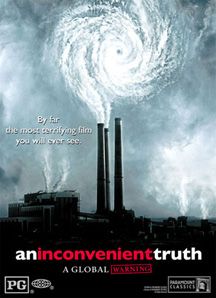
MOVIES: 'An Inconvenient Truth'


Oh Al Gore, I miss you. Watching "An Inconvenient Truth" the other day, I have to admit I felt a little sadness – in an alternate world, this guy'd be our president right now, instead of Dubya. Sigh. But so it goes.

Photobucket - Video and Image HostingIn his new documentary on the perils of global warming, “An Inconvenient Truth,” Gore has a message everyone on the planet should hear – Democrat, Republican, non-voter, American, foreigner, whatever you are. The human, funny warm Al Gore, the one so sadly missing during his presidential campaign, is your guide to a manmade horror story – that still has an optimistic perspective.

Quite simply, “An Inconvenient Truth” is the most important movie I’ve seen this year. Which makes it more the pity that there were only a dozen or so people at the show I attended, while a few doors down the latest “Pirates of the Caribbean” movie fills out to the aisles.

I know most folks view movies as a chance to escape from it all, but that’s not all they can or should be. “An Inconvenient Truth” is a movie that wants to wake you up, break you out of your apathy and the “if I don’t see it, it’s not happening mentality.” And it’s all done in an entertaining, relaxed fashion.

Check out “Pirates” and the like and have fun, of course, but if you’re at all concerned about the world you live in, and that your kids and grandkids will inherit, you owe it to yourself to see “An Inconvenient Truth.”

Photobucket - Video and Image HostingEssentially, “An Inconvenient Truth” is a filmed version of a lecture on global warming Gore has delivered hundreds of times around the world. It looks at the causes of warming, presents dozens of hard facts showing the problem is very real indeed, and then offers some hope of solution. Gore has a simple eloquence on screen, and presents himself far better here than he ever did during a political campaign. He’s a smart guy, but rarely overbearing, and there’s more than a little quiet thoughtful grace and poetry to some of his statements.

Director David Guggenheim nicely juxtaposes excerpts from Gore’s lectures with off-the-cuff interviews with the man around his Carthage, Tenn., home. Gore touches on the motivations behind his crusade – family crises, political losses – and shows how he decided it was time to use his time to make a difference.
Gore himself says he considers global warming to be a moral issue, rather than a political one. But some folks have politics so ingrained in their blood that anything heard from someone of “the other party” is going to close their ears.

Yet as Gore points out repeatedly, there’s no reason it has to be a choice between the economy or environment – both can co-exist, and as global warming persists, the economy will be harmed no matter what.

Occasionally, “An Inconvenient Truth” does bog down a bit in hard science. It’s difficult not to make the movie feel a bit like the college lecture it basically is. But generally Gore dumbs down the technical talk enough to make it palatable for everyone.

A dramatic series of events showing what could happen to the coastlines of some of the world’s major cities if sea levels rise is the best use of terrifying special effects I’ve seen in a long time – because unlike much of what we see in Hollywood, this has a decent chance of happening if something isn’t done.

“You can’t make somebody understand something if their salary depends upon them not understanding it,” Gore says at one point, quoting Upton Sinclair. It’s as good an answer as any to the obstinate refusal to note the obvious in some corners of Washington.

“An Inconvenient Truth” makes for a pretty convincing argument that there’s something really bad going on in our world today. It’s a question of whether the political will can be found to make a difference about it before it’s too late.

Tuesday, July 18, 2006

Shamelessly stolen from Greg "The Burg" Burgas


QuizGalaxy!
'What will your obituary say?' at QuizGalaxy.com
...Still alive, just in case anyone was wondering, but the maelstrom of life has been quite busy. Just about eight weeks now until we leave Oregon and we're rapidly picking up speed, moving downhill toward unknown territory... Now that we're nearing August, the real craziness begins.

Big huge yard sale Saturday was a smashing success, sold close to everything we had out there and no kooks or wackjobs to speak of other than the usual. We made money galore and then celebrated yesterday at the newspaper's staff picnic which I somehow ended up on the organizing committee for this year. Peter ran around being cute and singing his latest, the "A-B-C" song, to anyone who asked. So it's been busy. Tossing and turning in the sweaty summer nights, too much buzzing around the brain to be able to sleep decently... Coffee, coffee, where the hell's my coffee?

Seriously, doesn't anyone want our cat?

Thursday, July 13, 2006

LIFE: Bang! Zap! Pow! It's art!


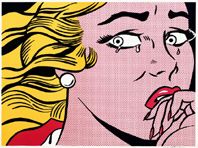
Photobucket - Video and Image Hosting…So last weekend we jetted up to Eugene to get some "cult-chah" and attend a kids' fest up there, and I swung by the Jordan Schnitzer Museum of Art at the University of Oregon to see a fab new show they've got of work by pop artist Roy Lichtenstein.

It was a good show, about 70 pieces, and reminded me of the Warhol show I saw there last year. I've always admired Lichtenstein's pop work, but like most I'm the most familiar with his "comic book-inspired" (some would say rip-offs) paintings. There's something kitschy and cool about those, but I also liked the chance to see some of Lichtenstein's other work at the show, his more abstract and avant-garde side.
Photobucket - Video and Image Hosting
The stark, "coloring book" style of some of his illustrations is confrontational and strange, especially when they're on paintings 5 feet across. It's almost like taking a peek into some alternate, Jack Kirby-created dimension. The benday dots that are a big part of Lichtenstein's style help create that otherworldly feeling. Its very fakeness makes it seem more real. Or am I just lapsing into pretentious critic-speak? Whatever – I likes it.

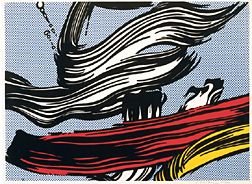
Photobucket - Video and Image HostingI rather liked pieces like this one, "Brushstrokes," right, that show the artist's style breaking down into its component parts. One of the exhibition's most interesting images was a six-part series showing a cow being slowly disassembled into fractal linework, like vision blurring.
Photobucket - Video and Image Hosting

Photobucket - Video and Image Hosting
But of course, you can't go wrong with a good ol' fashioned pop art explosion, either!

(All art (C) etc. Roy Lichtenstein estate, honest.)

Wednesday, July 12, 2006

Photobucket - Video and Image Hosting
Have I mentioned yet how much the American health insurance system SUCKS, and how very glad I will be to move to a country this October that actually has a system that makes a little more sense?

Yes, I just spent 15 minutes on hold trying to get a claims representative to tell me why the minor surgery I had in January still hasn't been processed yet... And still never got anyone on the phone. It's how it always is – you spend more hours working the phone trying to get the insurer to actually pay up anything than you spent at the doctor's. You see, this would've been settled in April or so if the insurer didn't send the check TO THE WRONG ADDRESS. Which means we'll likely never get this settled before we move.

I love my country. I hate its health care "system."

Tuesday, July 11, 2006

COMICS: A sneak peek at Alan Moore's "Lost Girls"


There's rarely a consensus when it comes to creativity, but ask comic book fans who the greatest writer of modern times is and one name will keep popping up again and again – Alan Moore. His library of comic work is legendary – Watchmen, V For Vendetta, Swamp Thing, Tom Strong, League of Extraordinary Gentlemen, From Hell and many more. Few have combined so well the traditions of fine literature with the conventions of comics, and fewer still have strained the borders of the comic panel like Moore and his collaborators. Again and again, Moore has pushed comics to be more than many thought they could be, tackling race, power, mythology and politics.

Photobucket - Video and Image HostingNow, in his latest, the massive magnum opus Lost Girls drawn by his fiancee Melinda Gebbie, Moore zeroes in on one topic guaranteed to draw eyeballs in – sex.

Lost Girls is a tremendous project, a set of three elaborately designed, oversized 112-page hardcover volumes to be published by Top Shelf Productions next month. It could scarcely be more designed to get attention, because in his sweeping examination of sex, lust and desire, Moore appropriates three of children's literature's most beloved heroines – from Alice in Wonderland, a grown-up, middle-aged Alice; from Peter Pan, the girl Wendy now a buttoned-up married woman; and from Wizard Of Oz, a sexed-up young adult Dorothy Gale.

Dorothy at an orgy? Oh no! Yet Lost Girls is an elegant, important work, miles away from the "Tijuana Bible" porn comics. At $75 for its entirety, it's also clearly not aimed at casual browsers. But, having read a preview copy, I can say it's without doubt one of the year's finest graphic novels – finest books, period.

It's a project Moore and Gebbie have been working on for nearly 20 years. Moore uses the "awakenings" each of the traditional stories contained and retells them in sexual terms (you can only imagine what the Tin Man and Scarecrow get up to with Dorothy, for instance). Yet slightly blasphemous as the notion seems, Moore is respectful to these characters in his way. "We didn't want to do something that was a sniggering parody of those works," he said in a recent interview. Lost Girls tells the tale of these three girls meeting in 1913, long after their famous adventures, at a strange private resort in France. The women are gradually drawn into each others' orbit, despite their very different personalities, and, instigated by the authoritative, debauched Alice, ascend into their own private universe of never-ending sensuality and dreams. As history is revealed, sex becomes more and more expansive, swelling up and flooding their everyday lives.

Read in one sitting, the three volumes of Lost Girls are a bit overwhelming, a constant parade of flesh-filled erotica and ever-escalating acts of desire. Like watching a lengthy porn movie, you get desensitized to it and start seeing perpetual nudity and sex as almost normal. It works far better read chapter by chapter, with pauses in between to reflect a little on what Moore and Gebbie are saying.

Photobucket - Video and Image HostingAll but the most worldly of readers will likely be astonished by how graphic Lost Girls is. As the tale unspools, Moore takes his characters into ever-more-elaborate pageants of pornography, from group sex to homosexuality and even, perhaps most troubling, incest and child sex. Yet this is ultimately non-exploitive porn with a soul, steeped in literary tradition, hearkening back to the legendary (and still shocking) work of the Marquis de Sade. Moore stands firmly on the belief that a fiction is a fiction, and cannot be held complicit for events in reality. "Pornographies are the enchanted parklands where the most secret and vulnerable of all our many selves can safely play," one character says. Lost Girls is id run amok, unapologetic.

Moore's work has grown in complexity and layers since his more mainstream material – his prose novel Voice of The Fire is almost Joycean in its cycling themes and references. Ditto his recent comic series Promethea, which moved from standard superheroine action into something quite magical and immense. Lost Girls is another step in the odyssey of this literary genius – a word I do not use lightly.

Moore gets us to think about the very nature of pornography. The very word itself has become a negative thing, largely because so much porn is hateful or merely artless. Yet by applying the full bore of his considerable talents upon the art of procreation, Moore reminds us that sex can be art. Very little porn out there is these days, but once upon a time, erotic fiction was a distinct, credible genre. Lost Girls is Alan Moore's most revolutionary work, designed to smash assumptions, crash barricades.

In a remarkable three-part interview at the Web site Comic Book Resources with writer Adi Tantimedh, Moore lays bare some of his motivations for what will be seen by some as a red flag in the culture wars: "Whatever urges there are out there are in our sexual imagination. And it seems to me that is a thing we fail to explore at our peril, if we allow shadowy, unexpected corners of it to remain where it is and never look inside them, and we end up with pretty much the type of society we've got now, where there is a fanatic outcry at anything suggestive involving a child where there is complete apathy at the number of children who are blown up every day in the world's war zones. Yeah, they only had their limbs blown off, but they haven't been touched sexually. That is something that is worth looking at."
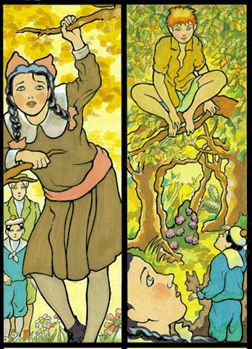
Photobucket - Video and Image HostingMuch of Moore's work involves a critical transformative event that breaks the border between worlds, such as the genocidal concentration camp that creates his "V" in V For Vendetta, or the murders of Jack the Ripper seen as a kind of invocation for the 20th century in From Hell. In Lost Girls, the telling of sexual histories by his girls is a chance for them to escape old hurts, embrace old pains and enjoy their sexuality unashamed. Wendy, from Peter Pan, is a tightly wound Victorian prude when we first see her, but gradually opens to embrace her lusty past with Moore's sexaholic Pan. Alice went "through the looking glass" to a terrible world where she was used and abused by others, only finally emerging with her own self-identity and pleasures. It certainly helps reading Lost Girls to be familiar with Oz, Pan and Alice, but even if you haven't read the original books many of their broad storylines are still familiar to us all.

Ultimately, Lost Girls is about whether we embrace violence or its gentler alternatives, our good or bad natures. There's a firm anti-war message wrapped up in the gaudy fantasia, as the grim events of World War I loom over and ultimately consume the three women's private paradise.

I've concentrated heavily on Moore's writing here because it's so commanding and confident, but I don't want to slight Melinda Gebbie's artwork. Moore's partner is an integral part of Lost Girls, and her beautiful artwork brings it to unforgettable life. Gebbie's gauzy, vaguely fairy tale-like style blends well with Moore's tale of self-exploration. It's also subtly versatile -- flipping through pages, you can really see how Gebbie tightens or loosens her style according to the demands of the tale. The colors are particularly gorgeous, done by hand without digital manipulation. Her style evokes an older era, yet has a modern tint. And her very presence as a muse for Moore's tale defeats any argument that Lost Girls is sexist – a ridiculous assault, as Lost Girls is far more told from the female point of view than male.

I'll be curious to see if upon its August release Lost Girls becomes another rallying cry for some conservatives, and causes outrage among those who aren't even going to read it. It would be a shame – in this very bold, very human saga, Moore has created a thesis on sexuality that stands with his finest work.


Saturday, July 8, 2006

MUSIC: Play me the blues


Busy busy busy. Besides, y'know, work, and trying to do a large review you should see sometimes next week, we're also getting ready for our ever-expanding mega yard sale set for a week from Saturday. So if you're passing through Southwest Oregon July 15, be sure to stop by! Say you read the blog and I'll give you a dollar discount. Unless it's on expensive stuff.

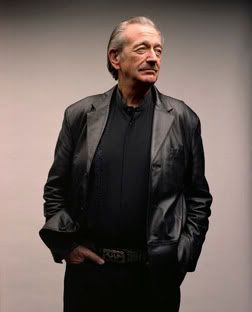
Photobucket - Video and Image HostingIn lieu of original content, though, let me point you toward an interview I got to do this week with blues harmonica legend Charlie Musselwhite, who's playing a free concert here next Tuesday. Always a pleasure to interview someone like Mr. M, who was gracious and eloquent on the phone, unlike his stumbling interviewer. Charlie's from Mississippi just like much of my family is so we had lots to talk about. He still wouldn't let me join his band, though. Anyway, if you're interested, go read my Ridin' with Charlie Musselwhite interview here.

Additionally, if you want to see the more refined version of my Superman Returns review (as opposed to the kind of rambling notes I posted last week), go hither. I'm still of two minds about that movie – flawed success, perhaps? worthy failure? – but it definitely tried to be ambitious, which you can't say about a lot of Hollywood summer movies.

Have a fine weekend!

Thursday, July 6, 2006

LIFE: A berry good time was had by all


Photobucket - Video and Image Hosting
Photobucket - Video and Image Hosting...Good lord, I feel like I ate my way through Independence Day. My folks came up for a visit for a few days and to visit their #1 grandson, and there was much eating of food, hiking, playing and so forth. One of our favorite things to do a couple times each summer around here is berry picking – we're in a big agricultural area and there's tons of strawberry, marionberry and blackberry farms, not to mention our absolute tops, blueberry picking. Took Peter out with my folks Monday for some berry pickin' adventures. This year's crop was the best we've seen in the 4 1/2 years we've lived here – huge, bright berries, falling right off the bushes. Then we stopped and bought pies at a local fruit stand. Hoo-ha!

So of course I made blueberry pancakes for our July 4 breakfast. And between my folks and I we've got about 10 pounds of berries to use in coming months. Berry-licious! The diet starts again next week.

Sunday, July 2, 2006

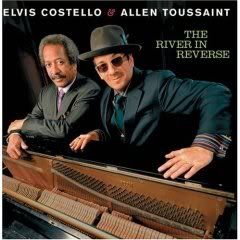
MUSIC: Elvis Costello & Allen Toussaint, "The River In Reverse"


Photobucket - Video and Image HostingI'm a big Elvis Costello nut, but I do get a bit leery when I see he's collaborating with other people or trying out a new genre. I love his variety and omnivorous musical mind, but it doesn't always pan out into fine music. Sometimes, it's fab, like his country-influenced "King of America" or his smoothly cool Burt Bacharach duets CD. Then sometimes you get an album like 2003's limp "North," toothless lite-jazz noodlings. He's even apparently put out an opera CD – and sorry, I'm not that dedicated.

So I didn't rush out and buy Costello's latest, "The River In Reverse," the day it came out. A collaboration with New Orleans R&B legend Allen Toussaint, I wasn't sure about it. I'm ashamed to say I wasn't really familiar with Toussaint (whom I learned is the man behind classics like "Working in the Coalmine") and didn't want to waste time on a pointless Costello side project. I apologize, Elvis – it's a great CD, your best since 2002's "When I Was Cruel."

Costello's worked with Toussaint before, on EC's venomous classic "Deep Dark Truthful Mirror" from 1989's "Spike." Costello apparently approached Toussaint last year at some benefit concerts for Hurricane Katrina victims and Costello whipped out a little song for the duo, "The River in Reverse." It was written and debuted in a show the same day, and led the men to to decide to try an entire album together, dedicated to the revival of New Orleans. (Here's a little more on how the album came to be.)

Photobucket - Video and Image HostingCostello does a lot of things wonderfully, but "he's got soul" isn't something I normally think of him. Yet "The River In Reverse" is packed with a warm Mississippi Delta soul, awash in the ghosts of New Orleans. It's got a soul that doesn't feel forced or faux-ironic, and a battered optimism that's truly appealing. I'm not real familiar with Toussaint, I admit, but he's a terrific collaborator for Elvis, with his fluid piano lines and the loose swing his songs have (about half the songs on the CD are Toussaint's compositions alone, about half joint works, and a couple of Costello solo works). The music has the groove of a jam, but the discipline of solid songwriting backing it up. The men are kindred spirits, balancing each other's strengths and weaknesses.

Throughout "River," a celebratory tone flows. It's not ignoring the recent devastation in the Big Easy, but it's looking back wistfully and what was and what hopefully will be one day again, in songs like "On Your Way Down," "Broken Promise Land" and more. There's certainly anger to be found about how muddled the human disaster was – "there's a place where words mean nothing or much less," Costello sneers in one tune – but Toussaint's lively arrangements balance out Costello's darker instincts. One of the disc's best songs is "Who's Gonna Help Brother Get Further?" which features Toussaint on lead vocals and bounces under a kicky bass line, punchy trumpet and organ. "What happened to the Liberty Bell I heard so much about?" Toussaint sings in a snappy couplet about the government's flubbed response to Katrina, "Did it really ding-dong? It must have dinged wrong / It didn't ding long." Sure, sounds silly written down, but trust me, it's a cool song.

"Tribute" albums often are more well-intentioned than truly good music. But by gently evoking the ideas and legends of New Orleans centered around some ripping fine tunes, "The River In Reverse" does the Big Easy proud.

Have a good 4th of July, all, I'll be visiting with the parents and back sometime next week with more posts.

Saturday, July 1, 2006

MOVIES: "Superman Returns"


Photobucket - Video and Image Hosting...It may be a bit silly, but I admit, there's nothing quite like hearing John Williams' awesome "Superman" theme music blasting into a movie theater for the first time in 19 (!) years, ever since I saw the god-awful "Superman IV: The Quest For Peace" in a theater with about six other people back in 1987.

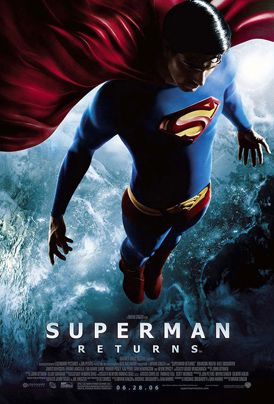
Bryan Singer's "Superman Returns" is the Man of Steel's first celluloid outing since then, of course, and if it isn't quite a total home run, it's solid entertainment and a pretty great spectacle. I'm not sure how well it'll do at the box office - it could catch on, or it could be seen as too cerebral and slow – but it more or less works. Some thoughts (Spoiler Warning, of course):

The good:

Like I said, that John Williams music is wonderful to hear again, and might just be my favorite movie theme ever. The whole movie is a deep thematic sequel to "Superman: The Movie" and "Superman II," and it's nice to see Singer paying respect to the godfather of the current superhero movie genre.

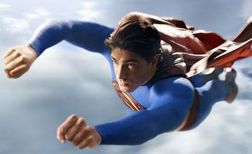
Photobucket - Video and Image HostingFirst off, some of the action in "Superman Returns" is absolutely spectacular – a dazzling plane rescue sequence in the beginning that had me holding my breath with tension; a series of incredible can-you-top-this feats of catastrophe prevention; any scenes with Superman flying, executed with stunning grace and majesty by Singer. Naturally, it's all a quantum leap above the effects in the 1978 film. You get your summer movie big-bang money's worth from this one, I think.

And overall, I'm down with Singer's approach to the material. Just like in his "X-Men" movies, he's respectful and utterly serious to the characters and story. There's a depth to "Superman Returns," with its lingering themes of alienation, fatherhood, truly adult love and hero worship. They aren't all developed perfectly, but this movie tries, and that elevates it to the higher echelon of comics flicks like the "Spider-Man" and first two "X-Men" movies or "Batman Begins."

Brandon Routh,
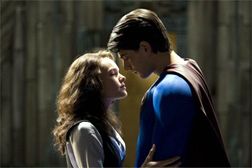
I wasn't sure about before I saw this – he looks too formless and bland in still photos, I think – but he's a very solid Man of Steel here. He plays Kal-El darker, more stoic and restrained than the late Christopher Reeve, who always had a nice kind of twinkle in his eye, but it serves for the story this movie is trying to tell. I don't think Routh's Clark Kent is quite as successful, but the Kent side of his personality really got the short shrift in screen time anyway.

Photobucket - Video and Image HostingKevin Spacey has been on most people's short list for Lex Luthor, and I think he's a fantastic choice here. He chews the scenery mercilessly, homaging Gene Hackman's performance but also turning this older, embittered Lex into more of a cruel, amoral thug. The dead steely glare in Spacey's eyes nicely fits this version of Lex, a madman whose plot in this tale is really quite insane and apocalyptic. At first I thought that was a gaping plot hole (not to spoil too much, but how is Lex's new land going to be valuable to anybody if it looks like Mordor-meets-South Dakota?), but now I can almost see that's the point. Lex is stone cold crazy here, and the rest of the world doesn't even quite get that.

A marvelous overall look to the film, dark but not "Batman" dark, with an art-deco Metropolis and a snazzy Daily Planet newsroom I'd love to work in.

The kid. I know many fanboy types are turned off any time a kid is featured in one of "their" movies, but I actually thought Lois Lane's son was a smart addition to the story and played by a refreshingly genuine child actor.

The final confrontation between Luthor and Superman is jaw-droppingly brutal and intense, and delivers a powerful punch. (I admit though I feel like Luthor doesn't get the comeuppance I feel he truly deserves at the film's end though.)

The just OK:
Photobucket - Video and Image HostingSorry, Singer, but Kate Bosworth as Lois Lane is a huge misstep. She's adequate, but rarely more, and lacks the husky lived-in sexiness of Margot Kidder's Lane. Obviously this isn't a straight sequel to the old movies, but still, how are we supposed to believe this doll-faced cherub is a hard-charging reporter? Bosworth just looks too young, and lacks the spark a Rachel McAdams or Rachel Weisz might've brought to the role. She does have a nice chemistry with Routh, though.

I like the notion of Superman leaving Earth for five years and dealing with the ramifications of coming back, yet the movie sometimes left me wanting more. Why exactly did it take five years? What did he see? There's almost another movie or something to be had from that story point alone. And the way Clark Kent kind of just slipped back into his old life after five years' away seemed a bit too simplistic.

The bad:
Singer is a fine director, but his ambition nearly derails the movie a couple times. It sometimes feels like a director's cut. It's too long by about 15 minutes, and takes a little while to get going. He lays on the Superman-as-Jesus metaphors far too thickly, to the point where it begins to feel artless and forced. (Although the movie's final scenes, featuring a badly wounded hero, were terrific.)

And while I love the old "Superman" movies, there's part of me that feels "Returns" errs a little too much toward being a remake rather than a total reinvention. Beside recycling the theme music, resurrecting Marlon Brando, the carved beauty of the Fortress of Solitude and even several dialogue lines from the original, the overall plot bears an awful strong resemblance to the first "Superman" movie (Superman vs. Luthor over some world-shattering real estate scheme). It's a good movie, but if there's a sequel I'd like to see them strike out in an entirely new direction.

Jimmy Olsen. Sorry, but this kid has only worked for me in the goofy 1950s and 1960s comics.

If Krypton crystals grow in water, why doesn't the Fortress of Solitude surrounded by ice take over the planet?

Despite the movie's flaws (and really, I can't think of a comics movie that's been flawless), I do find that I keep thinking about "Superman Returns." It sticks in your head, and Singer's visual imagery feels timeless and powerful. The first superhero has a movie that nearly lives up to its potential.